

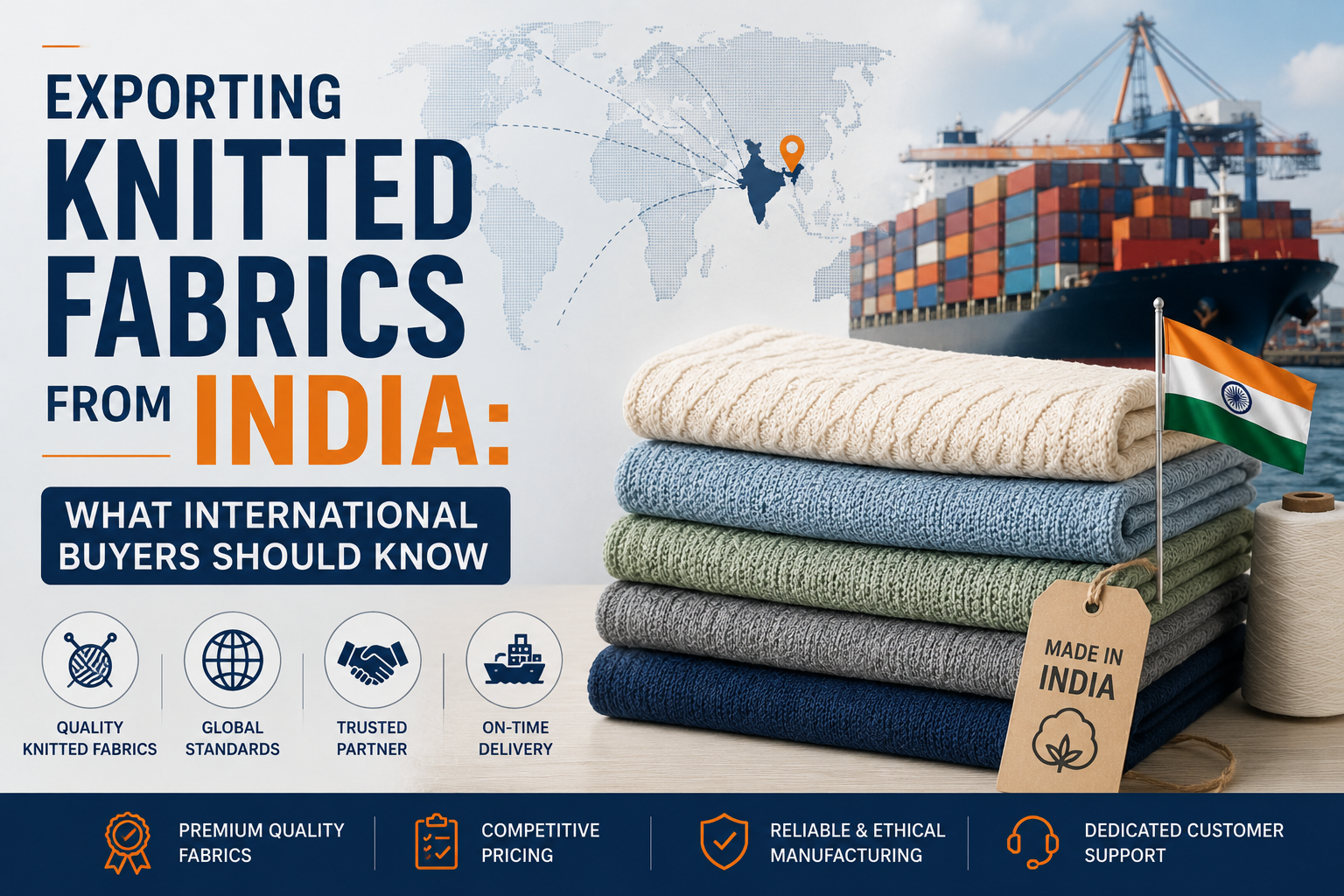
Introduction
India is one of the world's largest exporters of
textiles and garments. For international buyers
looking to source knitted fabrics or ready-made
garments, India — and specifically Surat — offers
some of the best value in the world.
But buying from India for the first time can feel
complicated. This guide covers everything you need
to know before placing your first order.
1. Why Source Knitted Fabrics from India?
Cost Advantage
- Manufacturing costs in India are significantly
lower than China, Turkey and Bangladesh
- Direct factory pricing means no middlemen markup
- Competitive freight rates from major Indian ports
Product Range
- India produces polyester, cotton and blended
knitted fabrics in all constructions
- Single jersey, interlock, fleece and rib available
- GSM range from 140 to 380 available from one supplier
Quality
- Indian textile manufacturers follow international
quality standards
- Many factories are ISO certified
- AQL inspection available on request
Export Experience
- India has decades of export experience
- Suppliers are familiar with international trade
documentation
- English speaking teams in most export companies
2. Understanding MOQ — Minimum Order Quantity
Most Indian fabric exporters have a minimum order:
Knitted Fabric : 200 kg per colour minimum
Garments : 300 to 500 pieces per style per colour
Why MOQ exists:
- Dyeing machines have minimum batch sizes
- Below MOQ, colour consistency cannot be guaranteed
- MOQ protects both buyer and supplier quality
Tips for first time buyers:
- Start with one or two colours to test quality
- Ask for a pre-production sample before bulk order
- Negotiate MOQ for repeat orders
3. How to Place an Order — Step by Step
Step 1 — Send your inquiry
Include: product type, fabric composition, GSM,
quantity, colours and delivery timeline
Step 2 — Receive quotation
A good supplier responds within 24 hours with
pricing, MOQ and lead time
Step 3 — Request samples
Always request a fabric sample or garment sample
before committing to bulk order
Step 4 — Approve and confirm
Give written confirmation of order with all
specifications clearly stated
Step 5 — Production and updates
Supplier produces your order with regular updates
Step 6 — Inspection and shipping
Final inspection, export packing and shipment
with full documentation
4. Documentation You Will Receive
For every export shipment from India you should
receive:
- Commercial Invoice
- Packing List
- Bill of Lading or Airway Bill
- Certificate of Origin
- GST / IGST Export Documents
Some buyers may also need:
- Phytosanitary Certificate
- Fumigation Certificate
- Test Reports (GSM, shrinkage, colourfastness)
Always confirm document requirements with your
customs broker before placing the order.
5. Payment Terms — What is Standard
Most Indian exporters work on:
T/T (Telegraphic Transfer)
- Most common payment method
- Standard terms: 30% advance, 70% before shipment
- Safe for both buyer and seller
L/C (Letter of Credit)
- More formal and secure
- Suitable for larger orders
- Preferred by buyers in some Middle East countries
For first time orders:
- Expect to pay more upfront (50% advance)
- Trust is built over multiple orders
- Better payment terms come with relationship history
6. Shipping from India — Key Facts
Main ports for textile exports:
- Nhava Sheva (Mumbai) — closest to Surat
- Mundra Port (Gujarat) — also close to Surat
Shipping time estimates:
- Middle East : 7 to 14 days
- Europe : 20 to 28 days
- Southeast Asia : 10 to 18 days
- USA / Canada : 25 to 35 days
Shipping options:
- LCL (Less than Container Load) for smaller orders
- FCL (Full Container Load) for large bulk orders
- Air freight for urgent small orders
7. How to Choose the Right Supplier
Red flags to avoid:
- No physical factory address
- No product samples available
- Prices too good to be true
- No export documentation experience
- Poor or slow communication
Green flags to look for:
- Clear factory address and verifiable location
- Willingness to send samples before bulk order
- Transparent pricing with no hidden charges
- Experience with your target country's requirements
- Quick and clear communication in English
Conclusion
Sourcing knitted fabrics and garments from India
is a smart business decision for global buyers.
The key is finding a reliable supplier with export
experience and consistent product quality.
At Adhya Exim, we have been manufacturing and
exporting knitted fabrics and garments from Surat,
India. We welcome first time buyers and are happy
to send samples before any bulk commitment.
Contact Us:
Email : hello@adhyaexim.com
Phone : +91 90331 17727
Website : www.adhyaexim.com
WhatsApp : +91 90331 17727